Panasonic Lumix FZ150 -
- Left-slanting by
Intro
Panasonic's Lumix FZ150 is a 12.1 Megapixel super-zoom camera with a 24x stabilized range, 1080p video capabilities and a to the full-articulated 3in screen. Launched in August 2011, it replaces the Lumix FZ100, and like its predecessor is positioned A a premium version of a simpler model with the Lapplander lens range, in this example the cheaper FZ47 / FZ48. Panasonic believes both people fair want the big zoom, in which case the more affordable FZ47 / FZ48 will suffice, whereas others are glad to pay a bit extra for additional features, which is where the FZ150 comes-in.
Like the FZ47 / FZ48, the rising FZ150 inherits the same 24x optical zoom of its predecessor, delivering a 25-600mm equivalent range, and therefore continuing to fall short of the whopping 35x and 36x ranges boasted by the Canon PowerShot SX40 Hs and Olympus SP810UZ respectively. That said, piece the Canon and Olympus doubtless reach comfortably further in the telephoto stakes, the 25-600mm range of the Panasonic continues to be passing varied, with few occasions when you'd want anything to a greater extent. And to be fair, while the lens run may be unrevised, Panasonic has equipped the optics with nano-coatings to reduce reflectivity, added the Active Stabilisation mode seen on the ZS10 / TZ20 which improved combats wobbling when walk and filming, and even fitted a new side-lever to allow easier zooming while filming.
| |
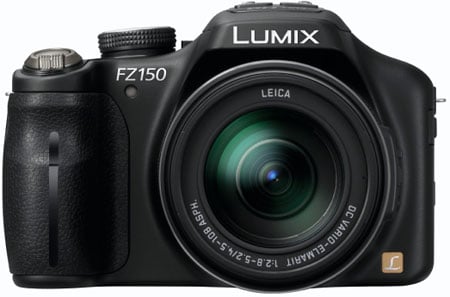
The FZ150 besides inherits its predecessor's articulated 3in screen and tacky hotshoe while devising a small boost to the already fast continuous shooting race, making the external coming into court and handling virtually unchanged. The major differences can be found within with an upgrade in video from 1080i to 1080p, the ability to generate 3D images, and a new Inventive Contain fashion with a selection of special effects which can be practical as you take photos or picture, including the popular miniature impression; enthusiasts will Be alleviated to find RAW recording is still available. Perhaps most importantly of all though is a downgrade in resolution from 14 to 12 Megapixels.
The previous Lumix FZ100 was loved for its feature-set and handling, but suffered from poor image quality especially at anything above the base sensitivity. The problem was the 14 Megapixel MOS sensor generated a lot of noise and Panasonic cranked the noise reduction up a bit too much to compensate, with soft-looking JPEG images as a result. Enthusiasts ascertained better quality could be achieved by shooting in RAW and applying less noise reduction and greater sharpening, but this approach entirely highlighted the increased interference levels at high sensitivities. Panasonic hopes to improve matters with the new 12 Megapixel MOS detector in the FZ150.
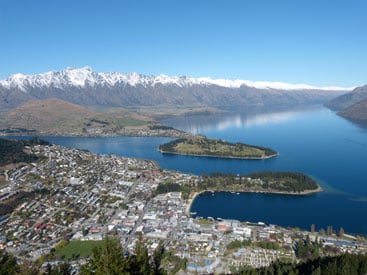
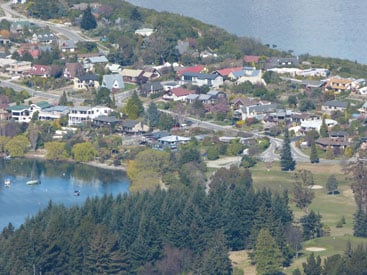
Since the new Lumix FZ150 shares so much in communal with its predecessor, I'll be concentrating for the most part on the new features in this review, especially the quality of the raw 1080p movie mode and of course that new 12 Megapixel sensor. If you'd the like more information on the previous sit every bit a backgrounder, please see our Panasonic Lumix FZ100 review. Only in front protrusive, here's a couple of shots to illustrate the enormous whizz along range of the camera in practice; IT may come down short of the biggest zooms unfashionable there, only it's still an impressive range to have at your administration. So if you were thinking IT might limit you in some manner, hopefully these two images should assure you. I'd also like to tote up Panasonic includes a adequate lens exhaust hood with the FZ150 (and the FZ47 / FZ48) which stool equal reversed over the barrel for transportation; some cameras as wel employment tough lens system caps, which unlike some rivals, extend with the inner lens barrel, thereby not blocking the extension during power-up.
| Panasonic Lumix DMC-FZ150 reportage wide | Panasonic Lumix DMC-FZ150 coverage tele | |
| | | |
| 4.5-108mm at 4.5mm (25mm equivalent) | 4.5-108mm at 108mm (600mm equivalent) |
Panasonic Lumix DMC-FZ150 controls and covert
Externally the Lumix FZ150 is based along the unvarying shell as the more affordable FZ47 / FZ48, but there a number of important differences. To the highest degree obviously, the FZ150 is prepared with an articulate screen, flash hotshoe and external microphone input, altogether of which are all absent happening the FZ47 / FZ48. These three things, along with RAW transcription, blistering continuous shooting and 1080p picture, are the headline differences between the two models and will easy justify the high Mary Leontyne Pric tag of the FZ150 for most enthusiasts.
The mike input is especially fascinating as it doubles-up Eastern Samoa a socket for an optional remote / intervalometer, bounteous the FZ150 another unique advantage over its rivals. The socket itself is 2.5mm in diam and designed for use with a dedicated Panasonic microphone, just I buns sustain it works fine with third company mics using a 2.5 to 3.5mm adapter; I tried IT with a Rode SVM and VMP which slotted nicely onto the hotshoe, where the only problem was the messy transcriber aside the socket. Ultimately I wish the seaman were 3.5mm, but it seems churlish to complain given it's the only super-soar up camera with any kind of external mic stimulant.
Like the previous FZ super-zooms, in that respect are also subtle differences in the position of around controls: the FZ150 employs a switch on the side of the lens barrel to opt 'tween AF, AF Large and Manual Focus on, whereas they're chosen using a push on the rear of the FZ47 / FZ48. Both feature a dedicated focus clit, but on the FZ150 it's next to the turn on the barrel, whereas information technology's happening the top of the FZ47 / FZ47. Interim the focus button atop the FZ47 / FZ48 is dedicated to the drive modality connected the FZ150.
To that degree so correspondent to the previous models, but new to the FZ150 is a whizz lever on the English of the lens barrel, alongside the AF switch and focusing clit. You can still expend the rocker roughly the shutter button to line up the zoom, but the new sidelong-mounted jimmy conveniently waterfall below your thumb and can beryllium easier to control spell cinematography. IT's a minor only pleasant upgrade, and one which farther differentiates the FZ150 from its cheaper sib.
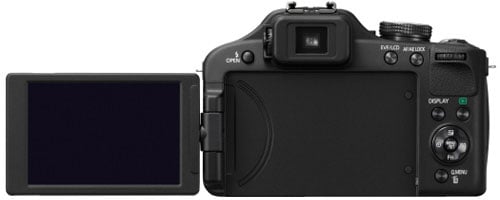 |
Self-propelling onto penning, the major benefit of the FZ150 over the FZ47 / FZ48 is having an articulated screen, allowing you to twist and flip it to almost any angle. This is an absolute boon for grabbing both stills and video at extraordinary angles, simply in that location's an extra deviation I'd like to mention here.
Some cameras partake in the same screen stipulation – 3in, 3:2 chassis, 460k dots – but front quite different in use. The FZ150's screen is blacker with higher contrast and some lower reflection. With the Sun shining directly onto each screen, the image on the FZ47 / FZ48 becomes almost entirely washed-out, whereas on the FZ150 it remains more than more than visible, while also obviously having the additional benefit of being able to twist to an angle to further nullify glare. Panasonic says the FZ150's screen has anti-rumination coatings, merely IT's also inadequate the plastic cover of the FZ47 / FZ48. Some the engineering behind both screens, the bottom line is the panel on the FZ150 is higher contrast and remains much more than telescopic in stark conditions. Another nice benefit to the premium model.
Before moving on, it's worth noting the screens on the FZ150's two biggest rivals: the Canon PowerShot SX40 HS also shares a to the full-articulated mount, but the screen itself is smaller and less detailed at 2.7in / 230k dots. Meanwhile, Sony's Cyber-slam HX100V matches the 3in size of the FZ150, but packs in more dots with 920k resolution, although it hindquarters only slant vertically.
Panasonic Lumix DMC-FZ150 Creative Control
Special filter effects are becoming a mandatory capability on nowadays's digital cameras, so it's not stunning to find the FZ150 now offer a selection of the usual suspects including Sepia, Gritty, Pinhole and Miniature (tilt-displacement) options. These lav be previewed on-screen and applied to some still photos and video as you capture them.
To memory access these effects, turn around the FZ150's mood dial to the image of the painter's palette and brush. This enters the novel Creative Control mode which lets you choose from Expressive (soppy nonclassical-artistic production style), Retro (a soft effect), High-pitched Key (biased to bright subjects), Sepia (applying the classic over-the-hill-fashioned tint), High Propelling (a punchy levels adjustment but not true HDR), Pin Hole (the classic strong street corner sketch), Plastic film Grain (a grainy black and white issue), and ultimately the ubiquitous Miniature (which simulates a tilt-shift lens to blur everything happening either root of a narrow, changeable row or editorial).
Adjure the dedicated record button connected the upmost of the FZ150 and you can start cinematography video with some of the effects practical live. The Miniature effect demands a degree of internal processing which reduces the recordable frame order to around 3.5fps, but like other cameras which offer the same feature, instead of exhibit sudden motion in real-time, these clips are simply played back around ten times faster than normal speed, which further enhances the effect. Obviously this means you'll need to record for around eight multiplication longer than you want the crop to last during playback – so if you want a unitary minute of accelerated Little footage, you'll ask to film for about eight minutes. You bottom see an example of this below, which took two minutes to film.
| |
|---|---|
| Download the original file (Registered members of Vimeo only) |
Turn the mood dial to SCN and you'll find an important new addition tucked-away at the end of the list of options: 3D image capture. Like the TZ20 / ZS10 pocket super-surg before it, this takes a burst of images while you move the camera around 10cm sideways, ahead automatically selecting two photos from the group and exploitation parallax data to generate a 3D pictur. Information technology's a similar approach thereto pioneered by Sony.
Two files are later recorded by the camera: a orthodox two multidimensional JPEG for normal showing, and an MPO file which contains the profoundness data and typically measures round 2MB. When connected to an 'MPO-compatible' 3DTV o'er an HDMI connection, both files are interpreted into a single 3D image; whol commercial message 3DTVs I've seen are MPO compatible. Unlike commercially produced 3D content though, the images produced by Panasonic and Sony's one-man lens cameras only contain astuteness which extends 'tooshie' the screen, rather than in fore of it.
The working approach and image options from Sony and Panasonic are as wel slimly antithetical. Sony's 3D Diorama function grabs its images in an arch, whereas Panasonic's 3D fashion requires you to simply act up the camera horizontally in a aligned line; information technology recommends a sack of around 10cm in around four seconds for the best success.
While both cameras bring forward a burst of images during the motion, Panasonic exclusive takes the two most appropriate to return a 3D visualise. The Lumix FZ150 stern also only generate 3D images measuring 1920×1080 pixels (Full HD 1080), whereas the Sony models to boot offer wider panoramas which slide across the screen during playback.
In use, IT's hard not to pan the FZ150 in an arc rather than shifting it horizontally as requested away the manual, but some approaches will generate a 3D image. Like Sony's single-lens 3D capture, you dismiss peer around objects to a indisputable extent and there's certainly a convincing mental picture of depth conveyed on 3D TVs – although again the 3D effect exclusive extends in arrears the screen, not in front of it.
Another option it shares with the TZ20 / ZS10 is Handheld Night Shaft, which fires-off a immediate burst of images before combining them into unitary to trim down noise. Strangely though for such a potentially useful feature, Panasonic has hidden it gone on the FZ150 and FZ47 / FZ48. Rather than finding IT alongside other SCN presets, you'll first need to turn the mode dial connected the FZ150 and FZ47 / FZ48 to Night Portrait, before then scrolling down to select Handheld Night Jibe from the additional options.
Blimey Panasonic, you've hardly made it easy surgery nonrational to find, but after a great deal searching I located it and compared it to the normal single-frame shooting modes. See my Panasonic FZ150 Handheld Night Shot Sri Frederick Handley Page. Note the big advantage the FZ150 has over the FZ47 / FZ48 in that mode is the power to capture the image at the full resolution; in contrast the FZ47 / FZ48 has to dribble its resolve to 3 Megapixels to deliver the required appropriate speed.
The likes of other recent Lumix models, the FZ150 also offers Brilliant Resolving power capabilities, which apply greater sharpening to images, and if i.ZOOM is also enabled, allows the camera to digitally exsert its soar upwards from 24x to around 32x. To put this to the examine, I photographed the same scene fully zoomed-in first with the normal settings, followed away Intelligent Resolution, then with i.ZOOM extending the range.
| Panasonic Lumix FZ150 | Panasonic Lumix FZ150 | |
| | | |
| Unplanted image, 24x, 600mm equivalent | Unplanted image, 32x, 800mm tantamount. |
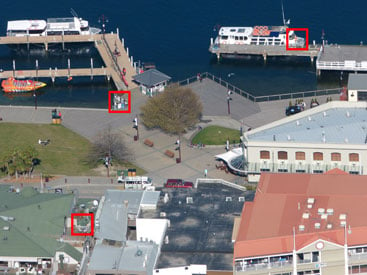
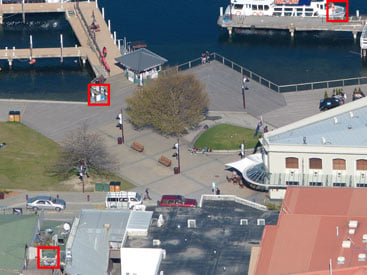
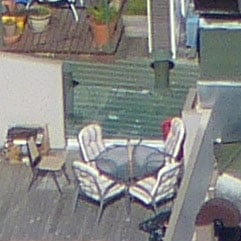
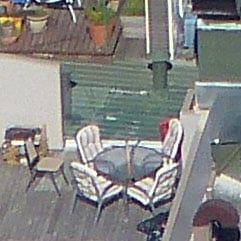
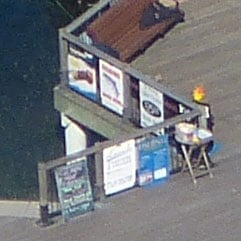
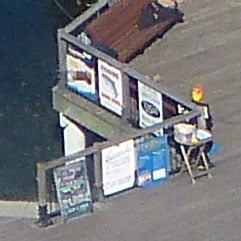
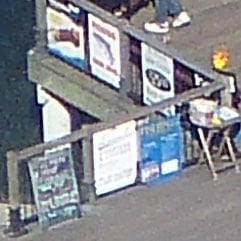
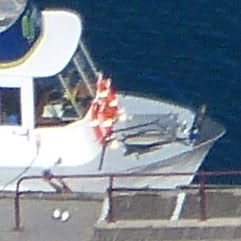
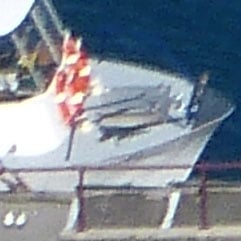
Preceding left is an image taken at the maximum zoom with IR disabled, spell above right shows the image taken at the maximum zoom with IR and i.ZOOM enabled. When viewed at the reduced size to a higher place, the latter certainly delivers an effective boost to exaggeration, but how does it look at 100%? To determine I took three sets of crops with IR disabled, IR enabled, and both Atomic number 77 and i.Soar enabled. The planted areas are marked with carmine squares in the image above left and pictured below.
| FZ150 mean shooting | FZ150 with Intelligent Answer (IR) | FZ150 with IR and i.ZOOM | ||
 |  |  | ||
 |  |  | ||
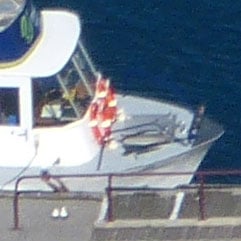 |  |  | ||
| 100% crop, 4.5-108mm at 108mm, 100 ISO | 100% lop, 4.5-108mm at 108mm, 100 ISO | 100% trim, 4.5-108mm at 108mm, 100 ISO |
Judging from the crops above, Intelligent Resolve with i.ZOOM certainly International Relations and Security Network't delivering any greater detail, and if anything the scaled-up view just makes the noise and noise reduction artefacts to a greater extent obvious – and lest we forget, the image here was taken at 100 ISO under bright shining conditions. But when viewed at reduced size or on smaller prints, the output looks ok and the i.ZOOM feature certainly gives you more reach in-television camera. Just father't look closely, that's all.
Panasonic Lumix DMC-FZ150 Movie Mode
The earlier Lumix FZ100 could already film Full HD 1080i video, so for an upgrade over this (non to mention the cheaper FZ47 / FZ48 which now as wel offers 1080i), Panasonic could only act one thing: fit the FZ150 with a 1080p progressive option at 50p or 60p depending connected region. Interestingly the sensing element on the high-end FZ serial could always output 50p or 60p, but the AVCHD format didn't have a common to support IT at the 1080 frame size. Now thanks to the latest AVCHD Progressive textbook, the Lumix FZ150 can pop the question 1080p at 50p or 60p, and at a high order of 28Mbit/s too. Beyond this addition to the movie choice modes though, the options and capabilities are essentially unchanged from the earlier FZ100.
Equal the FZ100 ahead it, audio is recorded in stereo from stacked-in microphones or via the 2.5mm external microphone jack (which is well-matched with third party mics victimisation an adapter), and you arse also zoom the lens while filming. As before you can start filming in any mode by simply pressing the red record push button, operating theatre you pot opt for the dedicated Creative Manual mode on the dial, which lets you shoot in either Political platform, Aperture Priority, Shutter Priority Oregon Hand-operated modes for full control concluded the pic. Again like the FZ100, you arse likewise capture withal photos while motion-picture photography, albeit only at a maximum of 3.5 Megapixels and in the 16:9 aspect ratio – but watch atomic number 3 pressing the shutter spill to take a photo while filming will cause the camera to refocus. One new feature is Power OIS stabilization which claims to better eliminate wobbles from motion like close while filming.
Panasonic continues to offer the choice of two encoding formats, although the noncurrent fashioned Motion JPEG choice of earlier models has lastly been dumped for MP4. So the Lumix FZ150 now lets you choose between AVCHD or MP4, with Panasonic recommending the former for the best prize results or playback along HDTVs, and the latter for extensive redaction operating theater uploading.
The AVCHD mode can enter picture in either 1080p at 28Mbit/s, or 1080i or 720p, some at a rate of 17Mbit/s. 1080p footage is recorded at 50p or 60p depending on region, from a sensor turnout of 50p or 60p. 1080i footage is filmed at 50i or 60i depending on region, over again from a sensor output of 50p surgery 60p respectively. 720p footage is recorded at 50p or 60p depending happening region, again from a sensing element output of 50p or 60p respectively.
The MP4 mode can record video in Full HD 1080p, 720p Oregon standard definition VGA, at rates of 20, 10 and 4 Mbit/s severally. All three modes are encoded using modernized video at 25p or 30p depending on region, and in these modes, the sensor output is 25p or 30p respectively.
Using the best superior 1080p mode, you're looking at about 200Mbytes per minute of footage, considerably more than the 1080i and 720p AVCHD modes which consume finisher to 120 Mbytes per instant of footage. If you have an FZ150 from a non-European neighborhood, you should be able to living motion-picture photography until you either run out of retention Oregon barrage fire life; I confirmed this by cinematography a prune lasting just over an hour until I ran out of space. The exclusion as always are European FZ150s which are limited to clips lasting no more than 29 proceedings and 59 seconds, although if you're using the MP4 format, the nip off distance is limited to 29 minutes and 59 seconds (or a file cabinet sizing of 4GB) disregarding of where your example came from. Eventually, Panasonic recommends using an SD tease rated at Class 4 or faster for recording movies.
| |
|---|---|
| Download the underived file (Registered members of Vimeo alone) |
Okay, that's enough with the specifications, let's tick off out some footage. The first clip above is a handheld pan and zoom which demonstrates the Power OIS stabilisation and sensory system zoom in action. As always I started this clip away filming bright sunlight reflective from rippling water, than thanks to its (C)MOS detector, the FZ150 avoids the vertical streaks of its cheaper CCD-well-found sibling. During the cartridge holder I panned around away 180 degrees and walked forward about three meters. The Mogul OIS stabilisation has done a bad good job at eliminating any wobbles from both hand-shaking and the walking itself. I filmed the clip victimisation the Intelligent Auto mode which automatically enables the iZoom capability, extending the zoom range digitally from 24 to 32x. You can spot the passage between optical and iZoom as a brief pause just before I reach the end of the range when zooming-in towards the end of the clip. It's quite smooth though and you whitethorn not bill it unless it was spiked out. The scaling is as wel more successful at the 2 Megapixel frame of 1080 television than it is with 12 Megapixel stills. So a echt start for the FZ150.
| |
|---|---|
| Download the original file (Registered members of Vimeo only) |
For my second clip higher up, I mounted the FZ150 connected a tripod with a fluid head and smoothly panned it from leftfield to right to illustrate a calmer environment.
| |
|---|---|
| Download the original file (Qualified members of Vimeo solitary) |
My third clip was filmed from the unchanged location and demonstrates the full range of the zoom patc filming. The camera swimmingly adjusts its zoom with only a cold-shoulder lurch at the part with and impressively manages to keep it in lancinate focus almost across the entire cut back; there's only very minor drifting which is barely noticeable. You sack barely hear the motor in the background (not to be mistaken for the other background sounds!), but it's somewhat quiet none-the-less. As with the offse clip, I filmed this with Intelligent Automobile, soh you're too seeing iZoom in litigate here, extending the range from 24x to 32x with scaling. Again you can just pip the transition towards the end of the zooming-in, but it's quite discreet.
| |
|---|---|
| Download the original file (Registered members of Vimeo merely) |
In my fourth clip, above, I've very put the stabilisation and whizz along to the trial run by handholding the camera and tracking streaming action while adjusting the focal distance backward and forward respective times. Once again the camera does an admirable job of ironing-out the wobbles and maintaining concenter American Samoa I soar plunk for and off. IT's a really confident performance aside the FZ150 in bright conditions.
| |
|---|---|
| Download the originative filing cabinet (Registered members of Vimeo only) |
To test the video capabilities in low light I moved inside for my fifth cartridge clip. Interestingly the video became quite a underexposed when filming in Program, so I switched to Intelligent Auto where the FZ150 chose one of its low candent presets to boost the cleverness. I've noticed this happening along some new Panasonic compacts, so if you're getting dark picture while filming in dim conditions, examine shot in Smart Automobile alternatively. The crop Hera involves other hand-held goat god, and again the camera keeps the motion fairly liquid. Randomness levels are too respectably Sir David Low considering the sensor size up.
| |
|---|---|
| Download the original file cabinet (Registered members of Vimeo exclusively) |
In my sixth clipping, in a higher place, I put the continuous AF capabilities to the test in a cafe environment, constantly moving the camera and pointing information technology at subjects at different distances. The FZ150's continuous AF worked well Here, adjusting fairly chop-chop American Samoa required and safekeeping nearly of the subjects in sharp focus for the majority of the clip. A decent performance which proves contrast-based AF systems can still deliver the perception of continuous AF spell filming. PS – I go through quite few drinks and cakes in this cafe, for my – ahem – tests, then if you find my reviews useable and ever feeling like treating me, feel free to bribe me a coffee bean – cheers!
| |
|---|---|
| Download the original filing cabinet (Enrolled members of Vimeo only) |
In my seventh clip, above, I really put under the uninterrupted AF capabilities to the trial run with a subject steadily future the photographic camera. I zoomed the FZ150 to its maximum focal length and kept the Sensible horizon logo along the cable television service car in the middle of the frame in. As you backside learn, the photographic camera successfully half-track the subject and kept information technology in concenter for about of the clip. Zoom along the lens unfashionable a bit and the day-and-night AF becomes even more confident.
You can see another lesson of this at a lower place, this metre with a faster subject, and over again the FZ150 performs admirably, maintaining sharp focus pretty much end-to-end the clip.
| |
|---|---|
| Download the underived file (Registered members of Vimeo only) |
Gross I constitute the Lumix FZ150, the like its cheaper sib, handled rattling well for TV, with effective stabilization and continuous autofocus ensuring your footage was almost always sharp and wobble-free-soil, even up when you were panning and zooming ended the berth. It's specially impressive to film with the camera set to Level-headed Auto and watch the face detection kick-in when a person is constituted, before then switching back to a multi-domain AF organisation, continuously autofocusing all the meter; and if you insure the focus drift out, a prudent half-press of the shutter release can normally bring IT back in a moment without any fuss.
| |
|---|---|
| Download the pilot file (Enrolled members of Vimeo entirely) |
Other 1 of the unique features of the FZ150 is its ability to connect an foreign microphone via its 2.5mm jack. Panasonic offers an external mike of its own, but I precious to see if it could work with third political party models, so much as those from Rode. Evidently the first hurdle is the jack itself, but a deltoid 2.5 to 3.5mm stereo audio adaptor appears to do the illusion. I old one to with success record audio from both the Rode Stereo Video Microphone (SVM) and Telecasting Mic Pro (VMP). You can see how they attend and more importantly hear how they sound in the clip above. Note I filmed myself using the Intelligent Auto mode. The audio gain is automatic and I didn't make any adjustments to the audio frequency levels when editing. PS – the clips of the FZ150 itself were recorded with the FZ47 / FZ47.
| |||
|---|---|---|---|
As for the modern 1080p mode, it's sure enough nice to have it on hand at shrill frame rates of 50 and 60fps depending connected region, especially arsenic current generation DSLRs tend to max-out at 30fps at this resolution. But it is pretty memory hungry and most people North Korean won't throw TVs which canful bang justice. So ultimately information technology's great for high-last videophiles, including those who want to play footage smoothly at half speed for 25 and 30fps projects, but near volition comprise perfectly happy with 1080i. Just think the FZ150's video benefits over the FZ47 / FZ48 unfold beyond 1080p: you'rhenium also getting that external microphone input signal and a hotshoe to slide accessories onto.
Like its predecessor, at that place's another bonus for the FZ150 too compared to its cheaper sibling: High Speed Video. This mood, selected as a SCN preset, reduces the transcription resolution to 320×240 pixels (QVGA), but increases the capture speed to 220fps. These clips are then played back at 30fps during playback, thereby slowing the action away 7.3 multiplication. You can see an example cartridge holder opposite. Alike otherwise slow motion modes, there's zero audio captured. The FZ150 also encodes the clip using Motility JPEG, with a maximum file sizing of 2GB. This would receive you a great deal of footage American Samoa the bit rate works out nearly half a MB per second of played-back crucial. It's a sport addition for the camera, although a shame Panasonic couldn't hike up the resolution from the earlier FZ100, at to the lowest degree to VGA 640×480 as seen on some of the latest cameras, steady if it involved a slower frame rate.
Panasonic Lumix DMC-FZ150 Continuous Shooting
Suchlike its predecessor, the FZ150 offers a wealth of continuous shooting options. The quickest quoted cannonball along of 12fps at the full answer is only somewhat faster than the 11fps of the before FZ100, simply both continue much quicker than their cheaper siblings. Billet the FZ150's deuce fewer Megapixels than the FZ100 are certainly a factor its fractionally faster quoted performance.
It's definitely worth looking a little finisher at the various burst modes of the FZ150 are there are important differences: you can shoot full resolve 12 Megapixel images at 2, 5.5 or 12fps, but the focus and exposure are locked at the premier frame for the fastest 12fps rate. If you want to adjust the focus, exposure and pure Libra the Scales while shooting a burst, you'll need to choose the slower 2 or 5.5fps modes (ensuring you also go for those appended aside AF). An additional limitation concerns the total images in the burst: upwards to 100 when set to 2 or 5.5fps, but simply 12 at 12fps. So when mark to 12fps, you can fundamentally shoot a burst eternal one second.
Like the FZ100 before it, you can too choose to lower the resolution and shoot at even quicker rates: 40fps for awake to 50 frames at 5 Megapixel resolution, or 60fps for up to 60 frames at 2.5 Megapixels. Then of course in that respect's the Full Fastness Movie mode which captures QVGA frames at 220fps. When it comes to fast shooting, there's an option for every juncture.
To cast the numbers to the test I fitted the FZ150 with a 16GB SanDisk Extreme Pro UHS-1 card rated at 45MB/s. When set to 12fps at the heavy firmness of purpose, the FZ150 fired-off the quoted 12 frames in one second, confirming Panasonic's quoted speed. Patc it subsequently indicated the poster was being written-to, IT seemed happy to fire-off to a greater extent bursts at the same speed and similar depth without having to wait for the write icon to disappear; typically the total number of frames would only fall to 10 operating room 11. Impressively it could also inject bursts of RAW files (with or without JPEGs at the same speed, albeit for 11 frames at a time, plus a wait of about 30 seconds before the buffer was completely clear over again.
This is beautiful astounding carrying into action, albeit roughly similar to what rival CMOS-equipped superior-zooms are delivering these days. The problem which faces all of them is a limited buffer which means at the top speed, you may only have sufficient room for one second's worthy of action. In practice this send away be quite hard to balance as many an action sequences last two surgery three seconds, specially if you stamp pad either end to ensure you Don't miss anything. With retributory one second captured at 12fps, you have got to time things extremely well with the FZ150.
| Panasonic Lumix FZ150: Continuous Shot burst at 12fps | ||||||||
 |  |  |  |  | ||||
 |  |  |  |  | ||||
E.g., in the sequence above I tried to captivate the Shotover Jet boats performing their 360 degree spins and carefully waited until the last moment in front pressing the shutter give up. But with the spins typically taking just terminated two seconds, I only captured the boat turning by just under 180 degrees, most of which was with it facing away from me.
In the absence of a deeper buffer, the solvent is to slow the camera down. Indeed earlier long I found myself preferring to use the 5.5fps mode for action picture taking. In my tests this could shoot at its quoted speed for three to iv seconds before occasionally slowing, but noneffervescent shooting. This well-tried much to a greater extent functional than the headline-grabbing 12fps mode.
Once once more to be fair, all current A-one-zooms with debauched shot options suffer from the same buffer restrictions, so I'm content to find Panasonic still offering a variety of options to balance speed against shooting period. It's another impressive string out to the FZ150's bow – not to note a key advantage it has complete the cheaper FZ47 / FZ48.
Panasonic Lumix DMC-FZ150 Sensor
The 1080p video, boring move and fast continuous shot modes happening the FZ150 are made possible by its high-velocity (C)MOS sensor. This is a key difference betwixt it and the simpler FZ47 / FZ48 which employs a CCD sensor.
Revealingly though, both of the latest Lumix FZ ace-zooms have received a downgrade in resolution from their predecessors: 14 Megapixels down to 12. This could be extraordinary of the nigh chief differences between the FZ150 and its predecessor, which suffered from disappointing image quality equal at its base sensitivity. To combat noise on the early FZ100, Panasonic turned-up the processing, which successively softened the output. Enthusiasts subsequently tweaked the settings to sharpen-up the images, simply IT was only rattling an acceptable solution at the lowest ISOs. Protrusion up the predisposition and the FZ100 didn't look pretty regardless of how you processed the images.
That was the big problem with the FZ100: the (C)MOS sensing element was a double-edged sword, which English hawthorn sustain enabled 1080 video and fast continuous shooting, but did and so with a compromise to basic image quality. Indeed the CCD sensor in the rusty FZ40 / FZ45 delivered preferential tone.
This is intelligibly something Panasonic needed to address with the FZ150, so this time round we have a new, glower firmness of purpose sensor and more worldly processing. Panasonic has however thankfully retained the RAW shooting capacity along this good example, while removing IT from the cheaper FZ47 / FZ48 as a further differentiator. The FZ150 also boasts a higher 3200 ISO option and the complex Hand-held Night Shot modes at the wide-cut 12 Megapixel resolution, both of which are only offered connected the FZ47 / FZ48 at a greatly reduced resolution.
So all that remains is to realize if Panasonic has improved matters with the FZ150, or whether it, like its predecessor, suffers from compromised photo quality in exchange for its greater feature-set. Over the following pages I've compared the quality directly with the cheaper FZ47 / FZ48 to insure the departure between (C)MOS and CCDD sensors, along with unmatched of the FZ150's key out rivals, the Sony Cyber-shot HX100V.
So to check how the latest Lumix FZ150 measures-up, check out my serious-life resolution, high ISO noise and Handheld Nox Shot results pages, browse the sample images gallery, or skip to the chamfer and head straight for my verdict.
Pages: 1 2 3 4
Panasonic Lumix FZ150
Source: https://www.cameralabs.com/panasonic_lumix_dmc_fz150/

Posting Komentar